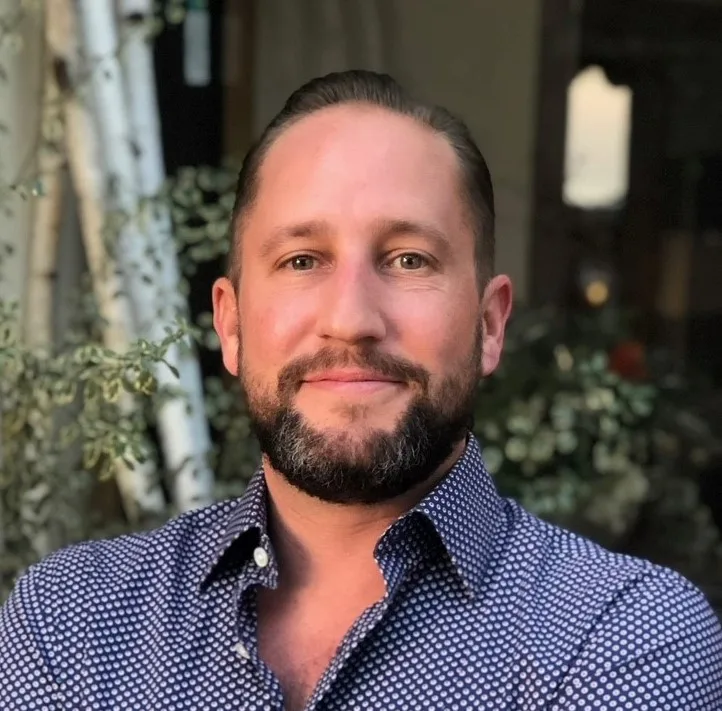
“The Most Frustrating Business I’ve Ever Loved”
Most chemical engineers who land at Procter & Gamble settle in for a thirty-year run. Thaddeus Thorne had that path mapped out. Instead, he stepped off a plane in California one February, thought about the Cincinnati winter he’d left behind, and spent the next two decades building foodservice categories that didn’t exist before.
Thaddeus leads the Thorne Collective, a La Jolla, California–based firm that helps purpose-driven brands build foodservice strategy, distribution, and broker partnerships across College & University, K-12, Business & Industry, healthcare, and national accounts. He currently serves as VP of Sales for The Spare Food Co. Before that, he helped put plant-based protein and acai bowls on the foodservice map.
From Process Engineer to Category Builder
At P&G, Thaddeus worked on Olestra, talked his way into a summer at the Pringles plant in Belgium, and later joined Folgers product development. “They didn’t really know what to do with me,” he says, “so they kept putting me on skunkworks projects.” One of them, a self-heating beverage container P&G chose not to launch, brought him west to help start that company.
Then his mentor Rick Bauman, a legend on the retail grocery side, recruited him to lead sales at Kim & Scott’s Gourmet Pretzels. That’s where Thaddeus discovered natural foods and foodservice—brokers, Dot Foods, national accounts—and fell for the channel. Bauman’s next call was about a plant-based chicken breast. That product became Gardein, and Thaddeus built the category from the ground up.
“I haven’t just launched brands,” he says. “I’ve launched categories, which is very, very difficult to do in foodservice.”
Brokers Execute Strategy—They Don’t Write It
When founders dismiss brokers, Thaddeus pushes back. “Brokers are paramount to what we do,” he says. Consolidation has made most of them excellent business managers rather than pioneers, and that’s structure, not failure. His rule: “You can’t outsource your strategy to a broker, your demand creation to a distributor, or your success to a contract.”
Solve the Operator’s Problem First
Too many supplier presentations spend five pages on company history before reaching the product.
“The value proposition gets you in. The brand connection keeps you in.”
Thaddeus leads with the operator’s problem—sometimes one they don’t know they have. At Sambazon, he saw college campuses losing students to the acai shop across the street. Once operators recognized that, they wanted the business back on campus, and acai bowls went national.
Recently, visiting a small OhioHealth hospital in Circleville, Ohio, he found a local family’s acai bowl trailer parked out front. “From Brazil to Circleville,” he says. “I did that.”
Pick Up the Phone
Ask what sets him apart and the answer is disarmingly simple: “I call people.” An email chain can drag on for weeks; a five-minute call settles it. He shows up in person, too, because a quick visit to a key account shows you care. A Cornell chef once said he likes working with Thaddeus because he never tries to sell him anything. “This is not a transactional business,” Thaddeus says.
Bandwidth, Not Appetite
Operators, especially in non-commercial, are asked to do more with less. “The industry hasn’t really lost its appetite for innovation,” he says. “It’s just lost the bandwidth to execute it.” That puts the heavy lifting on suppliers, including aligning culinary, purchasing, administration, the distributor, the broker, and sometimes a GPO. He calls it herding cats.
Advice for Newcomers
Love the business, because it will test your patience. Hire someone who understands foodservice segmentation and relationships, then actually listen to them; this is 180 degrees different from retail. And be patient. Even a big marketing budget can’t replace one operator meeting at a time. “We’re moving cases. We’re not moving trucks,” he says. Build that foundation, and eventually the cases turn into trucks.
The Through-Line
What connects the engineer, the category builder, and the consultant is a refusal to take the path of least resistance. Without people like Thaddeus, foodservice would be a lot more vanilla. Every hard-won acai bowl and plant-based entrée is proof that someone kept calling, kept showing up, and kept believing. As he puts it, “It’s the most frustrating business I’ve ever loved.”
Thanks, Thaddeus.
CONTINUE THE CONVERSATION
Follow Thaddeus and explore his work in foodservice strategy.