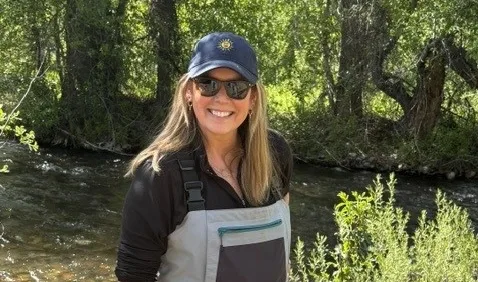
I’ve known Amy Shipley for years, mostly from across the table — we’ve crossed paths on commodity boards, industry events and more than a few shared contacts. But until we sat down for this conversation, I didn’t fully appreciate how much of her career was built on doing the opposite of what a seasoned agency veteran is supposed to do.
Amy is a managing partner who leads much of the B2C and B2B F&B and hospitality workleads the foodservice practice at SRG at SRG (Sterling-Rice Group), the Boulder, Colorado–based firm that works across brand positioning, culinary innovation, restaurant concept development, environmental design and integrated marketing for operators, suppliers and commodity boards in the U.S. and around the world.
Falling Into Foodservice
Amy grew up in advertising — her father ran a major East Coast agency, and her grandfather was in the business in London. A friend’s tip led her to Ketchum’s B2B food division, where she worked alongside some true legends of foodservice marketing. Early on, they asked her a simple question: “Can you read a recipe?” Then they sent her to cooking school for two years while she worked. “It really got me hooked,” she says. She stayed more than two decades.
The Year of Yes
When Amy moved to SRG to build its foodservice practice in earnest, she joined a firm that did everything from packaging to restaurant design. Her answer was to say yes to every project for a full year — including the ones she had no time for. “If I don’t believe, my clients can’t believe,” she explains. “I was exhausted, but it really helped me. I learned a ton.”
One Foot Out
SRG founder Rick Sterling once told Amy she always keeps one foot out of whatever she’s doing. She agrees. That objectivity lets her approach marketing like a CMO, blending PR, advertising and experiential into “one killer cocktail” rather than reaching for a single tool. “Nine times out of 10, a client comes to you with the wrong problem to solve,” she says. “You’ve got to untangle that first.”
She also has no patience for “fake it till you make it,” especially in a channel as specialized as foodservice. “You have to have enough maturity and confidence in yourself to say, I understand this, but I don’t understand that.”
Seeing the End of the Movie
Amy can usually see the end of the movie before her clients do. That lets her take bold but calculated risks — and she’s learned to bring her team along so they can see “the plan behind the plan.”
Her pitch for Avocados from Mexico proved the point. Instead of leading with impressions and big campaigns, she focused on one thing: making the growers money. She won the business and helped take it from zero to 60. “It all comes back to money, whether we like it or not,” she says.
Waiting for the Next Breakthrough
Amy remembers when fast casual and home meal replacement felt revolutionary, and she’s yearning for something comparable today — she’s seeing more of that energy in Japan and across Asia than here. Pressure to scale pushes new concepts toward the safe middle. “Playing it safe is really not what the restaurant business is all about.” For struggling legacy brands, she says the fix starts with brand positioning. As one of her SRG colleagues told a client — a line I will remember forever — “You’re not going to campaign yourself out of this.”
Lean Into the Discomfort
Her advice for newcomers: lead with the mentality of hospitality, explore the many paths this industry offers, and say yes. “When I start to get uncomfortable, I realize something magical is going to happen,” she says. “Every time, it works.”
That’s Amy — curious, candid and willing to go out on a limb when she knows where it leads. If you’re a foodservice brand, operator or commodity board wrestling with the right problem to solve, she’s a counselor worth calling.