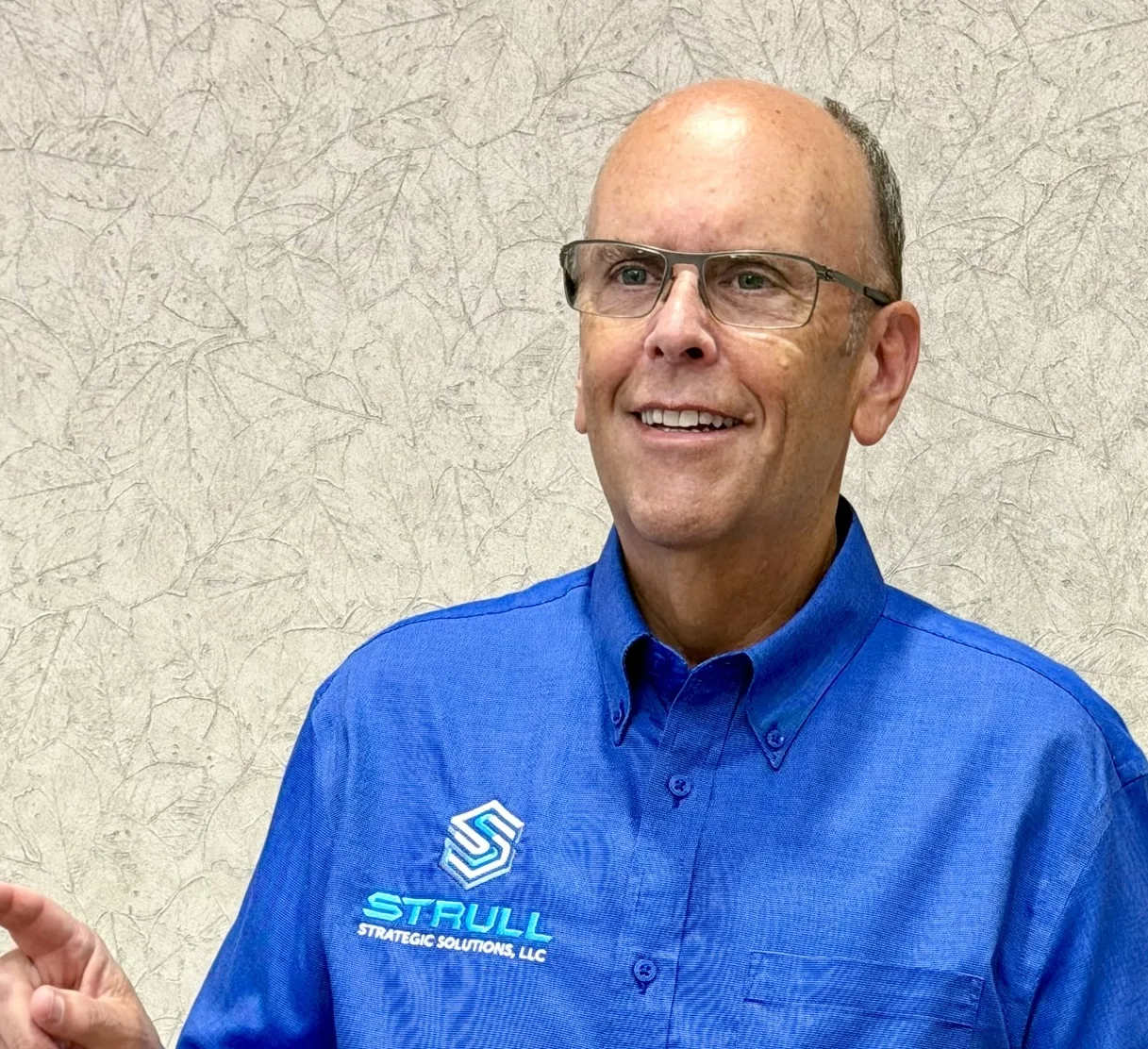
Scott Strull never planned a career in foodservice, the industry found him, more or less by accident, three separate times. First at 15, when a family friend offered him a busboy job the same afternoon he’d gone to pick up his freshman football playbook. (“I decided to save my knees”) Again, in his twenties, when he opened a San Diego newspaper looking for a marketing job and answered an advertisement for an outside sales rep at Durkee Food Service instead. And once more when a three-year commitment to the forerunner company, EMCO, quietly became a 30-year career at UniPro. “The doors open up,” Strull says of that pattern. “Don’t be afraid to step in.”
Today Strull runs Strull Strategic Solutions (SSS), an advisory practice based in San Diego. He works as a board advisor, board member, and investor for a select group of clients, focused on strategic initiatives, M&A integration, and enterprise growth. It caps five decades across nearly every corner of the food industry — restaurants, grocery retail, manufacturing, distribution, and buying groups — including 30 years at UniPro, where he rose from West Coast General Manager to a national leadership role, helping steer the industry’s largest cooperative.
The 90/10 Dilemma
Ask anyone who has worked with Strull and one phrase comes up before any title or deal ever does: the 90/10 rule. “Only 10% of the people out there actually do what they say they’re going to do, do it in a timely manner, follow through, and make it happen,” he says. “And 90% of the people out there tell me, oh, that’s me.” His answer to the gap is almost stubbornly simple: under-commit and over-deliver, and if a deadline is going to slip, say so before anyone has to ask. “You don’t have to call me and say, Scott, where is it? Because Wednesday morning, you’re going to hear from me first thing.” It isn’t a magic formula, he’s quick to point out — it’s just the basic, parochial stuff that most people quietly skip.
Home Runs Over Singles & Doubles
That discipline showed up early. In his first year as an outside sales rep at Durkee, Strull stopped canvassing every account on the street and instead went after a handful of marquee names — the San Diego Zoo, Sea World, Wild Animal Park, Atlas Hotels. “My success cascaded one over another,” he says. He won salesman of the year. Decades later, he’d put a name to the instinct after hearing former PepsiCo executive Indra Nooyi describe a 70-20-10 framework: 70% of time on the core business, 20% on opportunities that accelerate growth, and 10% on transformational bets that could reshape the business entirely. “I hit for the fences all the time,” Strull says, “but realize that the singles and doubles add up.”
Distribution Is the Third Leg of the Stool
Strull is direct about a mistake he sees manufacturers make repeatedly: talking only about operators and themselves and forgetting distribution entirely. “If you don’t connect with who distributes those products, I don’t care if you spend $10 million on the best marketing campaign out there — if you can’t deliver the product, and the customer says, I want X, and the response is, we don’t carry X, we carry Y, the customer will say, okay, send me Y,” he says. Unless a supplier is running its own direct-store delivery or drone fleet, he argues, distribution isn’t optional — it’s the third leg of the stool, alongside the operator and the manufacturer.
Where Retail and Foodservice Blur
Strull sees the line between retail and foodservice fading fast, and he points to the store perimeter — deli, bakery, prepared foods — as the clearest evidence. It’s why he brought AWG, a $13 billion retail cooperative, into UniPro years ago, along with other regional grocery co-ops. “The perimeter of the store is huge in foodservice opportunities,” he says. When he showed one cooperative’s leadership that a competitor was already selling over $10 million into their own retail accounts, the response was immediate: “This is a no-brainer.”
Scott’s advice for anyone starting out in foodservice is keep it simple: Be present, two ears, one mouth, in that ratio. Read people, know what you want to be known for, and build the kind of relationships where your word is the whole pitch. Five decades in, that’s still the secret to my success.
****
You can reach Scott at moc.liamg@snoitulostartsllurts